

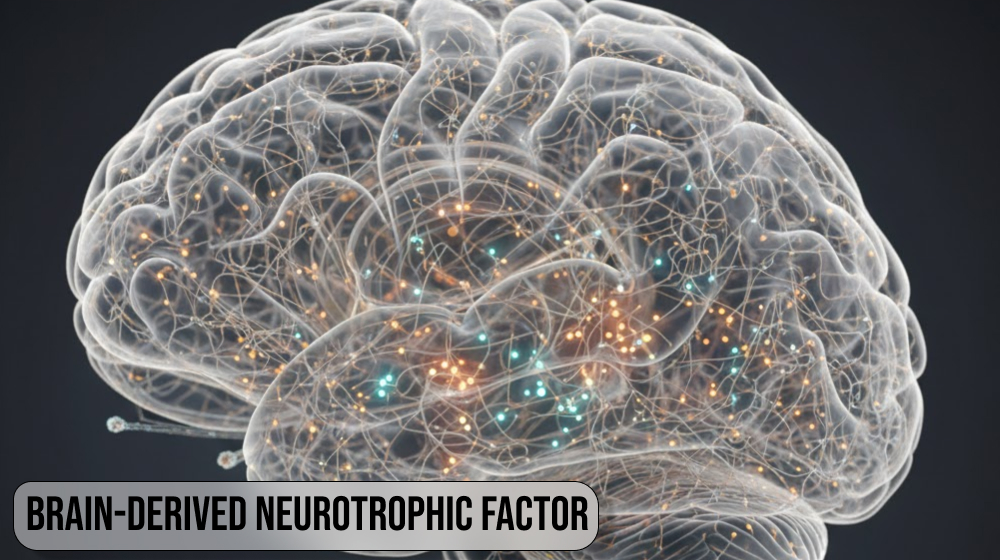
Brain-Derived Neurotrophic Factor (BDNF) is a protein that plays a central role in brain adaptability and resilience. It belongs to the neurotrophin family and is essential for neuron survival, growth, and communication. BDNF supports the formation and strengthening of synapses, which are the connections through which neurons transmit signals. These processes form the biological foundation of learning, memory, and cognitive flexibility. Without sufficient BDNF activity, the brain’s ability to adapt to new information and recover from stress is significantly reduced.
BDNF is active throughout life, but its levels fluctuate depending on lifestyle, stress load, and environmental conditions. It is especially important in brain regions involved in higher cognition and emotional regulation, such as the hippocampus and prefrontal cortex. Reduced BDNF expression has been linked to cognitive decline, mood disorders, and impaired stress resilience. From a biohacking perspective, BDNF represents a key leverage point for improving mental performance and long-term brain health.
- BDNF supports neuron survival and growth
- Synaptic plasticity depends on BDNF signaling
- Cognitive adaptability is linked to BDNF levels

How BDNF Supports Learning and Memory
Learning and memory are grounded in the brain’s ability to change its structure and function in response to experience. Brain-Derived Neurotrophic Factor (BDNF) is a critical mediator of this process, as it directly influences synaptic plasticity. BDNF enhances long-term potentiation, a cellular mechanism that strengthens communication between neurons after repeated activation. This strengthening allows neural circuits to encode new information more efficiently, making learning faster and more durable. Without adequate BDNF signaling, neurons respond less dynamically to stimulation, slowing the acquisition of new skills and knowledge.
BDNF is especially active in the hippocampus, a brain region essential for memory formation and spatial navigation. It promotes dendritic growth, increasing the number of synaptic contact points available for information processing. This structural support allows memories to be consolidated more effectively during rest and sleep. When BDNF levels are chronically low, memory formation becomes fragmented, and recall requires greater cognitive effort. Over time, reduced neurotrophic support contributes to cognitive rigidity and decreased adaptability, even in individuals without neurological disease.
- Synaptic plasticity depends on BDNF signaling
- Memory consolidation is strengthened by neurotrophic support
- Learning efficiency reflects neural adaptability

BDNF and Emotional Regulation
BDNF plays a foundational role in emotional regulation by supporting communication between brain regions involved in mood, threat detection, and executive control. Balanced BDNF activity helps maintain healthy connectivity between the prefrontal cortex, hippocampus, and amygdala. This connectivity allows emotional responses to be evaluated, contextualized, and regulated rather than being purely reactive. When BDNF signaling is sufficient, emotional states tend to stabilize more quickly after stress and adapt more flexibly to changing circumstances.
Chronic psychological stress reduces BDNF expression, particularly in the hippocampus. Elevated cortisol interferes with neurotrophic signaling and weakens synaptic resilience. Over time, this reduction impairs emotional memory processing and increases vulnerability to anxiety and depressive symptoms. Restoring BDNF through lifestyle-based interventions improves emotional recovery by strengthening neural circuits responsible for regulation and perspective. From a biohacking standpoint, emotional stability is not separate from cognition but is directly linked to neuroplastic capacity.
- Emotional regulation relies on neural flexibility
- Chronic stress suppresses BDNF expression
- Neurotrophic signaling supports resilience

Physical Activity as a BDNF Stimulus
Physical activity is one of the most consistently validated stimuli for increasing Brain-Derived Neurotrophic Factor (BDNF) in both the short and long term. During movement, especially aerobic exercise, the brain experiences increased blood flow, oxygen delivery, and metabolic demand. These physiological changes activate molecular pathways that upregulate BDNF expression in key brain regions, including the hippocampus and cortex. BDNF released during and after exercise enhances synaptic sensitivity, allowing neurons to respond more efficiently to stimulation and adapt to new patterns of activity.
The relationship between exercise and BDNF is dose-dependent but not limited to extreme training. Moderate, regular movement produces cumulative effects by raising baseline neurotrophic levels over time. This sustained elevation supports neurogenesis, synaptic maintenance, and learning capacity. In contrast, prolonged inactivity accelerates BDNF decline, reducing neural adaptability. From a biohacking perspective, physical activity acts as a biological signal that the environment demands learning, coordination, and resilience, prompting the brain to maintain plasticity rather than conserve resources.
- Aerobic exercise reliably increases BDNF
- Movement signals promote neural adaptability
- Sedentary behavior suppresses neurotrophic activity

Nutrition and BDNF Expression
Nutrition influences BDNF expression indirectly by shaping the metabolic environment in which neurons operate. The brain is an energy-intensive organ, and stable energy availability supports efficient neurotrophic signaling. Diets rich in essential fatty acids, adequate protein, and micronutrients provide the structural and biochemical support necessary for synaptic maintenance. Omega-3 fatty acids improve neuronal membrane fluidity, enhancing receptor responsiveness to BDNF and strengthening synaptic communication.
Conversely, chronic metabolic stress impairs BDNF signaling. Diets high in refined carbohydrates and inflammatory fats promote insulin resistance and oxidative stress, both of which interfere with neuroplastic processes. Elevated inflammation disrupts intracellular signaling cascades involved in BDNF synthesis and receptor activation. Nutritional alignment does not act as a direct BDNF trigger but preserves the internal conditions required for neurotrophic pathways to remain functional, responsive, and resilient over time.

Sleep, Circadian Rhythms, and BDNF
Sleep is a critical window for BDNF-mediated neural remodeling. During deep sleep and REM phases, the brain consolidates learning by strengthening relevant synaptic connections and weakening inefficient ones. BDNF supports this process by guiding synaptic refinement and structural plasticity. When sleep is sufficient and continuous, neurotrophic signaling remains robust, allowing the brain to integrate new information and recover from daily cognitive load.
Circadian alignment further regulates BDNF rhythms. Irregular sleep timing, nighttime light exposure, and fragmented rest disrupt hormonal patterns that support nighttime plasticity. Cortisol elevation and melatonin suppression interfere with neurotrophic expression, reducing the efficiency of overnight neural repair. Over time, chronic sleep disruption leads to lower baseline BDNF levels, impairing learning, emotional regulation, and stress tolerance. Stable sleep schedules and proper light hygiene protect the biological conditions required for sustained neuroplasticity.
- Sleep quality regulates BDNF activity
- Circadian stability supports neural recovery
- Nighttime remodeling depends on deep sleep

Aging, BDNF, and Cognitive Decline
A gradual decline in BDNF levels is a natural part of aging, contributing to reduced neural flexibility and slower cognitive processing. This decline affects memory formation, learning speed, and emotional adaptability. However, aging does not eliminate neuroplastic potential. The trajectory of BDNF reduction varies significantly depending on lifestyle factors, including physical activity, cognitive engagement, and metabolic health.
Individuals who consistently stimulate neurotrophic pathways maintain higher levels of synaptic integrity and communication efficiency later in life. Exercise, learning, and circadian stability slow the functional consequences of aging by preserving BDNF signaling. Rather than reversing aging, neurotrophic support maintains brain function closer to its adaptive baseline. In this context, BDNF is a stabilizer of cognitive capacity, extending functional longevity rather than promising unrealistic optimization.
- Aging reduces baseline neurotrophic levels
- Lifestyle factors modulate decline rate
- Plasticity remains biologically possible

Final Thoughts on “Brain-Derived Neurotrophic Factor”
Brain-Derived Neurotrophic Factor (BDNF) represents one of the most important biological mechanisms underlying cognitive performance, emotional stability, and long-term brain resilience. Rather than acting as a single switch, BDNF reflects the brain’s overall readiness to adapt, learn, and recover. When neurotrophic signaling is stable, neural circuits remain flexible, communication between brain regions is efficient, and cognitive load is processed with less effort. When BDNF activity is chronically suppressed, the brain shifts toward conservation, reducing plasticity and slowing adaptive responses.
Modern lifestyles often create conditions that quietly reduce BDNF levels. Sedentary behavior, disrupted sleep, chronic psychological stress, and metabolic instability all interfere with neurotrophic signaling. These factors rarely cause immediate cognitive failure, which makes their impact easy to overlook. Instead, the effects accumulate gradually, appearing as reduced learning speed, emotional volatility, mental fatigue, and decreased stress tolerance. Understanding BDNF reframes these symptoms not as isolated issues, but as signs of impaired neural adaptability.
What makes BDNF optimization especially relevant is its integrative nature. Physical activity, circadian alignment, nutrition, and recovery do not act independently; they converge on neurotrophic pathways. Supporting BDNF does not require extreme protocols or constant intervention. Consistent biological signals that indicate movement, safety, and recovery are enough to maintain healthy levels. This makes BDNF a practical focus for sustainable brain optimization rather than short-term cognitive enhancement.
From a biohacking perspective, BDNF highlights an important principle: the brain responds best to environments that resemble those it evolved to handle. Regular movement, predictable light-dark cycles, restorative sleep, and stable energy availability all communicate that adaptation is necessary and safe. When these signals are present, the brain invests resources in plasticity rather than defense.
In the long term, BDNF should be viewed not as a performance enhancer, but as a maintenance system. It preserves learning capacity, emotional regulation, and cognitive resilience across decades. By prioritizing the conditions that support neurotrophic signaling, it becomes possible to slow functional decline and maintain mental clarity without relying on constant stimulation. In this way, BDNF serves as a foundation for both everyday cognitive health and long-term neurological longevity.
- BDNF signaling reflects brain adaptability
- Lifestyle alignment sustains neuroplasticity
- Neurotrophic support enables long-term resilience