

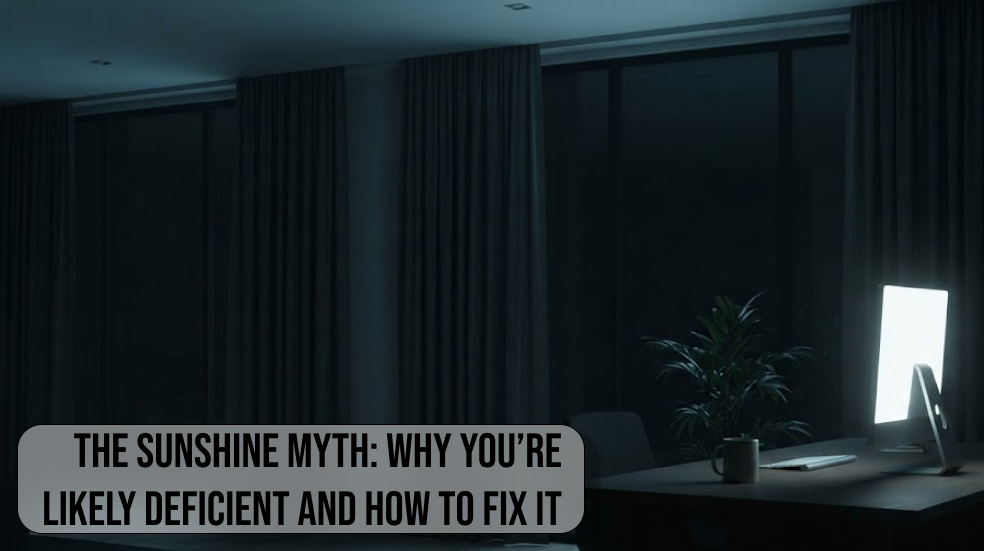
The Sunshine Myth: Why You’re Likely Deficient and How to Fix It. For most of human history, natural Vitamin D synthesis was an unavoidable consequence of daily existence, fundamental to our biological rhythm. Today, however, the modern lifestyle has engineered an indoor existence, separating the body from its primary evolutionary driver. While public health messaging has long emphasized protecting skin from UV damage, this has inadvertently fostered a widespread belief that the sun is an adversary. This cultural shift, often termed the sunshine myth, suggests that avoidance is the only path to safety, ignoring the catastrophic health costs of chronic Vitamin D deficiency and the systemic breakdown that follows when the endocrine system is starved of solar radiation.

The reality is that natural light acts as a complex signaling mechanism for the human body, directly influencing the production of Vitamin D. When the skin is shielded from UVB rays, the body’s internal pharmacy fails to trigger the synthesis of this essential precursor, which is vital for immune function and mental clarity. Over-sanitizing our environment to eliminate UV exposure has created a physiological vacuum, where the internal clock loses its tether to the solar day. Reclaiming your health requires a departure from absolute sun avoidance toward a balanced strategy of intentional, controlled exposure that respects the power of the sun while ensuring your Vitamin D levels remain within an optimal, health-promoting range.
- Modern architecture and office culture have shifted human activity almost exclusively indoors, limiting natural Vitamin D production.
- Misguided dermatological advice has prioritized total UV avoidance over healthy, moderate exposure necessary for Vitamin D synthesis.
- The absence of solar stimulation disrupts the body’s fundamental homeostatic mechanisms regulated by Vitamin D.

The Biochemical Foundation of Vitamin D
At the core of the global Vitamin D deficiency crisis lies a fundamental misunderstanding of how the human body converts solar energy into active biological currency. When UVB rays strike the skin, they trigger a chemical reaction converting 7-dehydrocholesterol into cholecalciferol, the primary form of Vitamin D. This isn’t merely a vitamin; it is a potent, steroid hormone that governs the expression of thousands of genes. Without this hormonal signal, the body enters a state of persistent metabolic confusion, struggling to regulate calcium absorption, bone density, and the complex inflammatory pathways that are heavily dependent on adequate Vitamin D status.
Supplementation is often proposed as a universal panacea for those living in sun-deprived climates, yet it rarely replicates the full suite of systemic benefits provided by Vitamin D from sunlight. Oral intake lacks the immediate, localized activation of the body’s own stores and misses the ancillary benefits of near-infrared light exposure that accompany natural solar synthesis. Furthermore, relying solely on pills often masks the underlying lifestyle failure—an inability to synchronize daily habits with natural environmental cycles. To optimize your health, you must bridge the gap between simple supplementation and the profound physiological response triggered by direct contact with the sun to maintain healthy Vitamin D levels.
- Vitamin D functions biologically as a master steroid hormone that regulates thousands of unique genes.
- Oral supplementation often fails to trigger the same breadth of gene expression as sunlight-derived Vitamin D.
- Inadequate solar interaction directly impairs the body’s ability to manage inflammation via circulating Vitamin D.

Redefining Sun Exposure for Longevity
The pursuit of longevity requires a recalibration of how we approach our environment, moving away from binary labels toward a nuanced understanding of dosage to maintain stable Vitamin D levels. The goal is not to maximize tanning, but to achieve a consistent, low-level stimulation of the endocrine system that maintains a healthy baseline of serum 25(OH)D levels. This requires a strategy centered on the solar angle; during hours when the sun is low, UV radiation is insufficient for Vitamin D production, while midday exposure offers the highest efficiency with the shortest duration needed.
By strategically timing your exposure, you can minimize the risk of DNA damage while maximizing the synthesis of the critical Vitamin D precursors needed for health. Many individuals unknowingly sabotage their progress by attempting to “catch up” on sunlight during weekend marathons, a behavior that leads to burning rather than adaptation. Instead, consistency is the biological priority for stabilizing your Vitamin D status. Short, frequent exposures that never reach the point of skin reddening allow the body to gradually increase melanin production, creating a natural internal shield that protects you while facilitating the absorption of the specific light spectrums required to synthesize Vitamin D efficiently.
- The solar angle is the primary determinant of efficient, natural Vitamin D production throughout the year.
- Intentional, frequent, short-duration exposure prevents skin damage while boosting Vitamin D levels.
- Developing natural melanin adaptation is a protective strategy that supports sustained Vitamin D synthesis.

Circadian Rhythm and Light Signaling
Sunlight is not only a source of essential Vitamin D but also the most potent synchronizer of our circadian rhythm. Every cell in the human body contains peripheral clocks that must be reset each morning by exposure to full-spectrum natural light. This light signal, captured through the retina, travels to the brain, which orchestrates the timing of cortisol release in the morning and melatonin production at night. When you remain in the dim, artificial world of indoor lighting, you miss out on both the Vitamin D synthesis and the neurological cues required for optimal metabolic health.
Reclaiming your energy levels begins the moment you wake up. Viewing the morning sky initiates a cascade of neurochemical events that prepare the body for high-functioning activity. While morning light is crucial for the circadian clock, remember that peak Vitamin D production occurs when the sun is higher in the sky. By prioritizing both morning light for rhythm and midday light for Vitamin D, you reduce reliance on chemical stimulants to force alertness. This alignment between your biology and the external environment is the single most effective intervention for those seeking to repair a broken sleep architecture and stabilize their daily energy while keeping Vitamin D levels high.
- Natural light serves as the primary environmental cue for resetting internal biological clocks alongside Vitamin D production.
- Morning sun exposure is essential for proper hormone cycles, while midday sun is best for Vitamin D.
- Indoor lighting environments fail to trigger the neurological signals needed for daytime alertness or Vitamin D synthesis.

The Role of Infrared and Near-Infrared Light
Beyond the visible light spectrum and the UVB rays that create Vitamin D, lies the often-overlooked benefits of near-infrared light. Unlike UV rays, which trigger the production of Vitamin D, infrared light penetrates deeply into the tissues, supporting mitochondrial function and increasing ATP production. This specific wavelength helps to mitigate oxidative stress and inflammation, providing a buffer against the potential damage caused by higher-intensity light. Many people who feel “revitalized” after being outside are experiencing the combined therapeutic effects of this invisible spectrum and the boost in Vitamin D.
Harnessing this energy is particularly beneficial for those with high levels of sedentary stress. By ensuring your daily sun exposure includes periods when the sun is higher in the sky, you receive this deep tissue stimulation that is missing from standard UV-based health advice. While technology like red light therapy can supplement this, nothing replaces the broad-spectrum immersion of the natural sun which facilitates the best Vitamin D absorption. Integrating this awareness into your routine transforms sunlight from a source of anxiety into a functional tool for recovery, allowing you to optimize physical performance and delay aging through improved Vitamin D status.
- Near-infrared light penetrates deep tissues to enhance mitochondrial ATP production, complementing Vitamin D health.
- Broad-spectrum solar exposure provides a balance that mitigates potential oxidative cellular stress during Vitamin D synthesis.
- Natural infrared radiation acts as a restorative agent for physical recovery, enhancing the systemic benefits of Vitamin D.

Navigating Modern Safety Concerns
The fear of skin damage is a rational response to rising dermatological issues, yet it has been extrapolated into an irrational rejection of the sun and Vitamin D production. The solution is not to hide, but to understand the photoprotective capability of the body, which relies on adequate nutrition and balanced Vitamin D levels. High levels of systemic inflammation, often fueled by processed oils and refined sugars, make the skin far more susceptible to UV-induced damage, regardless of your Vitamin D status. Conversely, a diet rich in antioxidants provides the skin with a “nutritional sunscreen,” bolstering its inherent resilience.
Moving toward a healthier relationship with the sun involves upgrading your internal terrain before focusing on external protection. When the skin is well-nourished, it is inherently more capable of handling exposure without defaulting to an inflammatory response. Additionally, understanding the distinction between moderate exposure—necessary for Vitamin D—and excessive burning is vital. Sunscreen has its place for high-intensity, prolonged periods, but using it as a default for five minutes of midday sun prevents the body from ever receiving the vital signals. Shift your focus toward building tolerance through diet and consistent, safe sessions.
- Dietary intake of antioxidants provides natural, systemic protection against UV damage, supporting safer Vitamin D accumulation.
- Systemic inflammation from processed foods leaves the skin vulnerable to radiation, complicating Vitamin D acquisition.
- Smart exposure strategies include using protection only for high-intensity periods while allowing daily Vitamin D synthesis.

Final Thoughts on “The Sunshine Myth: Why You’re Likely Deficient and How to Fix It”
The journey toward optimal health is rarely about finding a single, miraculous solution; rather, it is about restoring the fundamental biological connections that have been severed by modern convenience. By dismantling the pervasive “sunshine myth,” you take the first step in recognizing that Vitamin D is not just an optional supplement but a foundational pillar of human physiology. When you intentionally re-engage with natural light, you are not merely “going outside”; you are providing your body with the precise, high-level signaling required to calibrate your immune system, regulate your mood, and stabilize your metabolism through consistent Vitamin D production.
As you move forward, remember that the goal is not perfection, but persistent alignment. Every minute spent in the morning sun or during a midday break is an investment in your long-term cellular resilience. By prioritizing these small, manageable windows of exposure, you allow your body to synthesize the Vitamin D it desperately needs, moving you away from the systemic, low-grade fatigue that plagues so many in our indoor-centric culture. This shift in perspective transforms the sun from a source of apprehension into your most powerful, accessible, and free tool for achieving peak performance and sustained vitality.
- Integrating regular, intentional sun exposure creates a biological foundation that no amount of synthetic supplementation can fully replicate.
- Prioritizing Vitamin D status through natural solar interaction is a cornerstone of effective, evidence-based biohacking.
- Consistency in your daily light habits is the ultimate secret to unlocking energy, mental clarity, and improved sleep quality.


